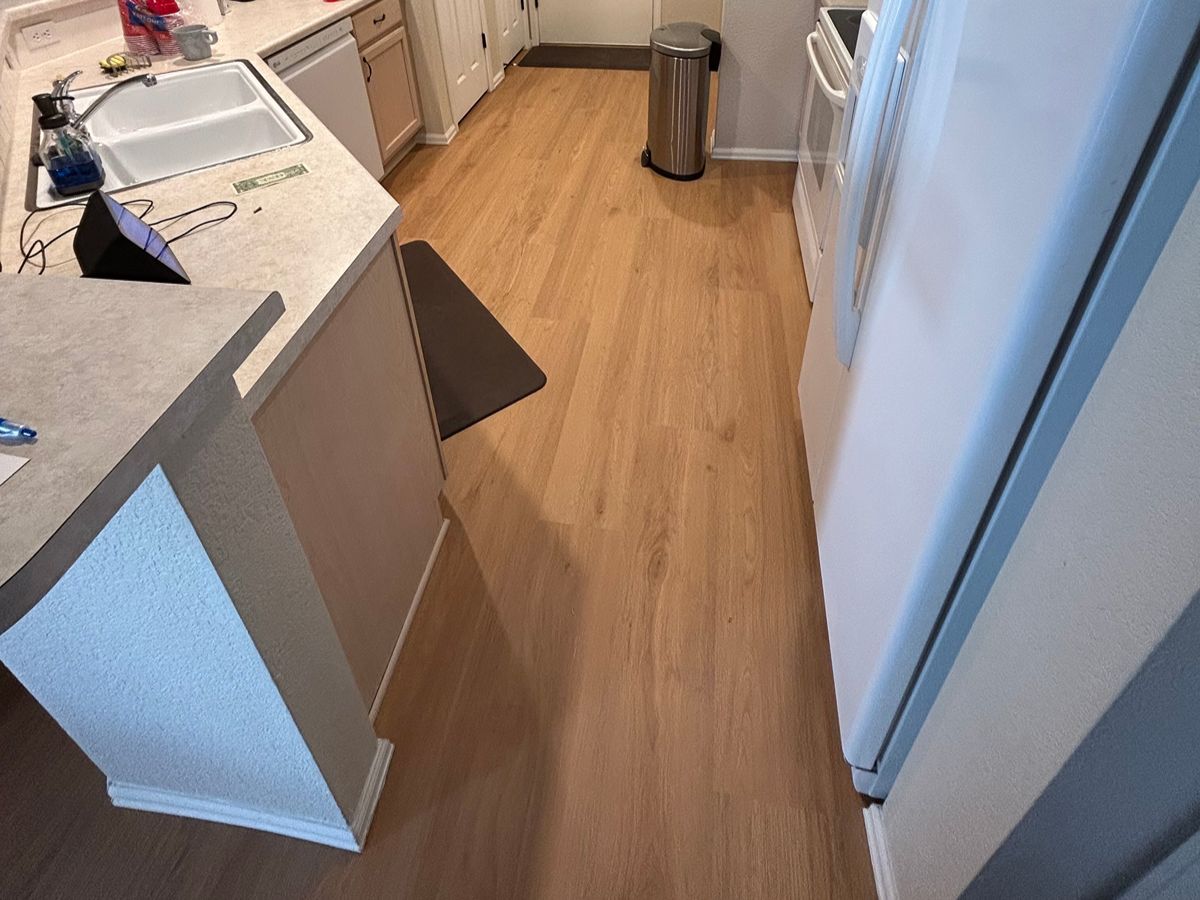
Yes, if the floor has enough real wood on top. Whether you can refinish an engineered hardwood floor depends mostly on the thickness of that top layer of real wood, called the wear layer. The National Wood Flooring Association’s guidance is that a wood floor should not be sanded once the wear layer is less than 3/32 of an inch, which is about 2.38mm. If your top layer is thinner than that, sanding is off the table, and refreshing the finish is usually the option left.
The question is especially relevant in downtown condos and converted lofts around LoDo and Union Station, where you may have inherited a floor with no record of what it is. People move in, live on the floor for years, and eventually want it looking fresh again.
Engineered hardwood is built as a layer of real wood bonded to a core of plywood, fiberboard, or lumber. That top layer is the only part that can be sanded, and sanding into the core often means replacing the board. Real hardwood installed as one solid board can be sanded many times over its life because it is wood all the way down. With engineered, the whole decision hinges on how much wood is sitting up top.
Total plank thickness does not tell you how much wood you can sand. Engineered wear layers run from paper-thin veneers to several millimeters. The number that matters is the wear layer alone, measured in millimeters, and that is the figure to hunt down before anyone brings out a sander.
How can I tell if my floor is engineered hardwood or real hardwood?
Look at the edge of a board, where the difference in construction shows. Solid hardwood is one continuous piece of the same wood from top to bottom, so the grain runs straight through. Engineered hardwood shows a thin band of real wood on top sitting over a separate core of plywood, fiberboard, or lumber, and that line between the two is easy to spot once you know to look for it.
You do not have to pry up a plank to see this. In a Denver condo or bungalow, the easiest spots to check are a floor vent, a doorway transition, or the gap under a stair nose, anywhere a cut edge is already exposed. Pop the register grate at a heating vent and you can usually see straight down the side of a board.
Age can be a clue. In early-1900s streetcar neighborhoods like Congress Park, where most houses went up between 1900 and 1929, an original floor is more likely to be solid wood, while newer construction and units built over concrete are where engineered tends to turn up. If you still have any paperwork, a purchase receipt or a spec sheet from the builder, it will name the product and often list the wear layer outright.
How to tell if engineered hardwood can be refinished?
Measure the wear layer, then compare it to NWFA’s 3/32-inch (2.38mm) line. Find an exposed edge at a vent or transition and measure just the top band of real wood with a ruler or a caliper. A floor that can be sanded and refinished needs enough of that layer left to survive the process, since a traditional sanding job takes off somewhere between 1/32 inch and 1/16 inch of wood each time, which works out to roughly 0.8mm to 1.6mm of the wear layer.
Common wear layer thicknesses:
- Under 2mm: too thin to sand. Refreshing the finish is usually the realistic option.
- Around 2mm: sits at or below the NWFA threshold, so it is not a realistic candidate for a full sanding.
- 3mm: clears the line, with room for at least one full refinish, depending on how much each sanding takes off.
- 4mm and up: more headroom, which can allow more than one refinish over the floor’s life.
Not every engineered floor qualifies at all. Some products carry a veneer under 1mm thick, far too thin to sand, so they can be recoated but not refinished. When the number is borderline, it is worth having someone measure it at the lowest point before committing.
Can engineered hardwood be sanded and restained?
Only if the wear layer is thick enough to sand all the way down to bare wood. Restaining rules out a simple recoat, because changing the color means sanding off the old stain and finish completely and getting back to raw wood so the new color can take. That is a full refinish, so the floor needs enough wear layer to survive one.
On a floor with a 3mm or thicker veneer, a full sand-and-restain can be done, as long as the sanding stays within the wear layer. On thinner veneers, it is not, because you would cut through the wood and expose the core. Once the core shows, a cosmetic repair is sometimes possible, but the board often has to be replaced.
Textured floors are harder still. On wire-brushed or hand-scraped planks the wear layer varies across the surface, and NWFA’s technical guidance says these floors are extremely difficult and often cannot be sanded. Sanding one flat to restain it also erases the texture. If a color change is the goal, that is a detail worth working through before the job starts.
What are the downsides of refinishing engineered wood floors?
The biggest risk is sanding through the veneer. Once the sander reaches the core, a cosmetic touch-up is sometimes possible, but it often means pulling the board and putting in a new one. On a thin-veneer floor there is very little wood to work with, which is why measuring first matters so much.
Beveled edges raise the risk too. Many engineered planks have a slight V-groove between boards, and sanding the floor flat cuts into those edges, thinning the wear layer right where it is already thinnest. You also get far fewer refinishes than with solid wood. A solid floor can often be sanded six to eight times, while an engineered floor gets fewer, and how many depends on its wear layer.
Color matching is the other headache. If a few boards need replacing after a burn-through, matching a discontinued engineered product to the rest of the floor is tough, and a patch that does not match stands out. For thin-veneer floors where sanding is off the table, recoating the existing finish is usually the way to freshen them up.
If your engineered floor is looking tired and you are not sure whether it has the wood to survive a sanding, get it measured before anyone brings out a sander. Every wood floor refinishing job we do in Denver starts with a free in-home estimate and carries a 100% satisfaction guarantee plus 18 months of warranty coverage, whether a problem comes from our work or from something you did. Give CMC Flooring LLC a call at (720) 382-3006 or request a visit online, and we will come take a look before anyone touches your floor.