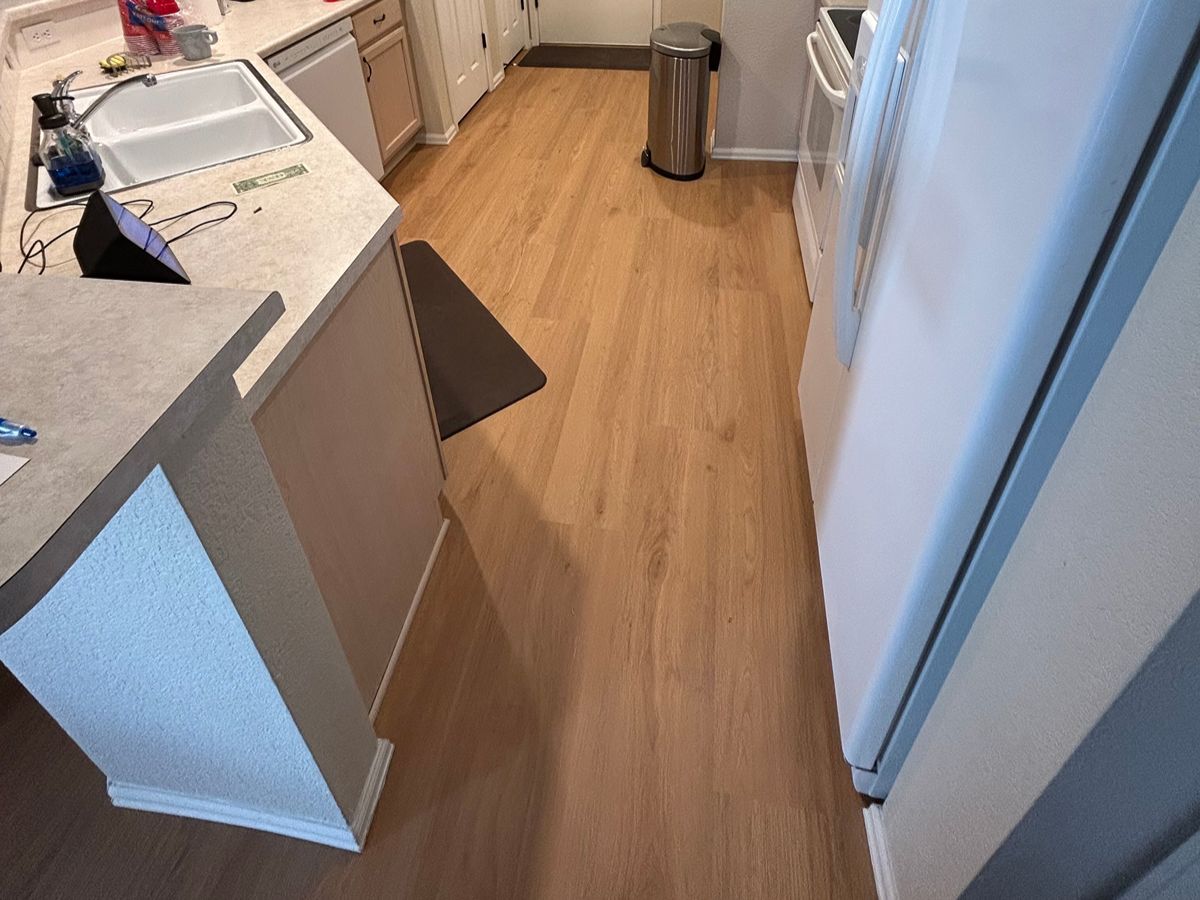
For most Denver homes, engineered hardwood is the safer pick, mainly because Denver’s air is so dry that indoor humidity routinely drops below 20 percent during heating season, and a layered core moves far less than a solid board when that happens. Solid hardwood is still an excellent choice in the right room, but the choice really comes down to where the floor is going and how long you plan to keep it.
Denver sits at 5,280 feet, and that thin, arid air is the single biggest factor in how a wood floor behaves here. A floor spec that works fine near the coast can gap or cup in a Front Range winter, so the smarter question is not which material is better overall, but which one fits the room and the way you live in it.
The core difference is in the build. Solid hardwood is one piece of wood, usually about three-quarters of an inch thick, all the way through. Engineered hardwood is a real-wood veneer bonded to a stacked plywood or fiberboard core, with the layers running in opposite directions. That cross-ply construction is what gives engineered its stability, and it is why the material holds its shape over concrete, in basements, and through big swings in indoor moisture. Solid wood looks and feels the same underfoot, but it reacts more to the air around it.
Denver’s climate is the reason this matters more here than in a lot of places. The National Wood Flooring Association recommends keeping indoor relative humidity between roughly 30 and 50 percent year-round to protect wood floors. The trouble is that winter heating drives Denver’s indoor humidity well below that, sometimes under 20 percent, which pulls moisture out of wood and opens gaps between boards. Add in the housing stock: a huge share of homes across the metro have finished or finishable basements sitting on a concrete slab, and a below-grade slab can carry humidity up from the soil, so a floor that swells or warps with moisture is a poor fit down there unless the space is exceptionally dry and sealed. That single fact rules solid hardwood out of a lot of Denver basements before the conversation even starts.
Can engineered hardwood be refinished?
Yes, but how many times depends entirely on the thickness of the wood veneer on top. Engineered hardwood has a thin layer of real wood over a plywood or fiberboard core, and that veneer thickness sets the ceiling on sanding. The industry standard from the National Wood Flooring Association is that engineered hardwood should not be sanded at all once the wear layer drops below 2.5mm (3/32 inch), which is a flat threshold rather than a sliding scale. A 2 to 3mm wear layer usually allows one careful sanding. Sand past the veneer and you hit the core, which means replacing boards.
Solid hardwood is a different story. A standard three-quarter-inch board has about three-eighths of an inch of wood above the tongue, and that wear layer lets a solid floor be sanded and refinished several times over its life. If your floor only looks dull or lightly scratched rather than worn through, a screen-and-recoat instead of a full sanding refreshes the finish without removing any of that wear layer, which is often the right call for engineered floors you want to preserve.
Which one adds the most value to a home?
Both add real value, but solid hardwood tends to carry a stronger premium with buyers because they know it can be refinished and outlast them. In Denver’s competitive resale market, real wood of either kind reads as an upgrade over laminate or vinyl, and a well-chosen engineered floor with a thicker veneer is hard to tell apart from solid once it is installed.
Where engineered can actually add more value is in spaces solid wood cannot safely go. Finishing a basement is one of the most common ways Denver homeowners add usable square footage, and putting a genuine wood floor down there ties the space into the rest of the house in a way LVP does not. Keep in mind, though, that appraisers typically value below-grade space at about half the rate of above-grade space, so match the material to the room. On the main level, either wood holds its value well. In a basement, engineered gives you the wood look without the risk, and that stability is worth more over time than a solid floor that starts gapping the first winter.
What is the difference in lifespan between engineered hardwood and regular hardwood?
Solid hardwood lasts the longest, plain and simple. Because it can be sanded and refinished repeatedly, a well-kept solid floor can last many decades, sometimes the life of the house. Every full refinish removes only a sliver of wood, so a solid floor can go through several cycles across a lifetime of use.
Engineered hardwood has a long service life too, but it is capped by that veneer. Once the top layer is sanded through, the floor gets replaced rather than refinished. A quality engineered floor with a thick wear layer can serve for a couple of decades or more, especially since its stability means it is less likely to develop the seasonal gaps that plague solid wood in Denver’s dry winters. So the honest tradeoff is this: solid wins on total lifespan if it is installed somewhere it can stay stable, while engineered often wins on staying flat and gap-free through Denver’s humidity swings. In a bone-dry Green Valley Ranch winter, a stable engineered floor that never gaps can outlast a solid floor that is stressed year after year by the same conditions.
What is the cost difference between engineered hardwood and solid hardwood?
Engineered hardwood usually costs less installed than solid hardwood, and the gap comes from both the material and the labor. Solid hardwood is 100 percent lumber, so the raw material runs higher, and the install is more involved. Solid planks are nailed down, which takes more time and skill, while engineered can go in faster with floating or glue-down methods, keeping labor lower.
Over a small room the difference is modest, but across a larger area the price gap between the two widens, which makes engineered the more cost-effective option for big projects. There is also the long game to weigh. Solid costs more upfront but can be refinished many times, so over enough decades it can cost less per year of use. Engineered saves you money now and skips the finish work, which is often the right trade for a basement or a slab where solid should not go anyway. For a specific number tied to your square footage and the room you are flooring, an in-home estimate is the only way to get an accurate figure, since species, grade, and subfloor prep all move the price.
Choosing between engineered and solid hardwood in Denver really comes down to where the floor is going and how the room handles our dry, high-altitude air. We help you sort that out in person, bringing samples to your home so you can see the wood in your own lighting and pick the construction that actually fits the space, then handling the install and standing behind it with a full 18-month warranty. When you are ready to talk it through, reach out to CMC Flooring at (720) 382-3006 for a free in-home estimate.