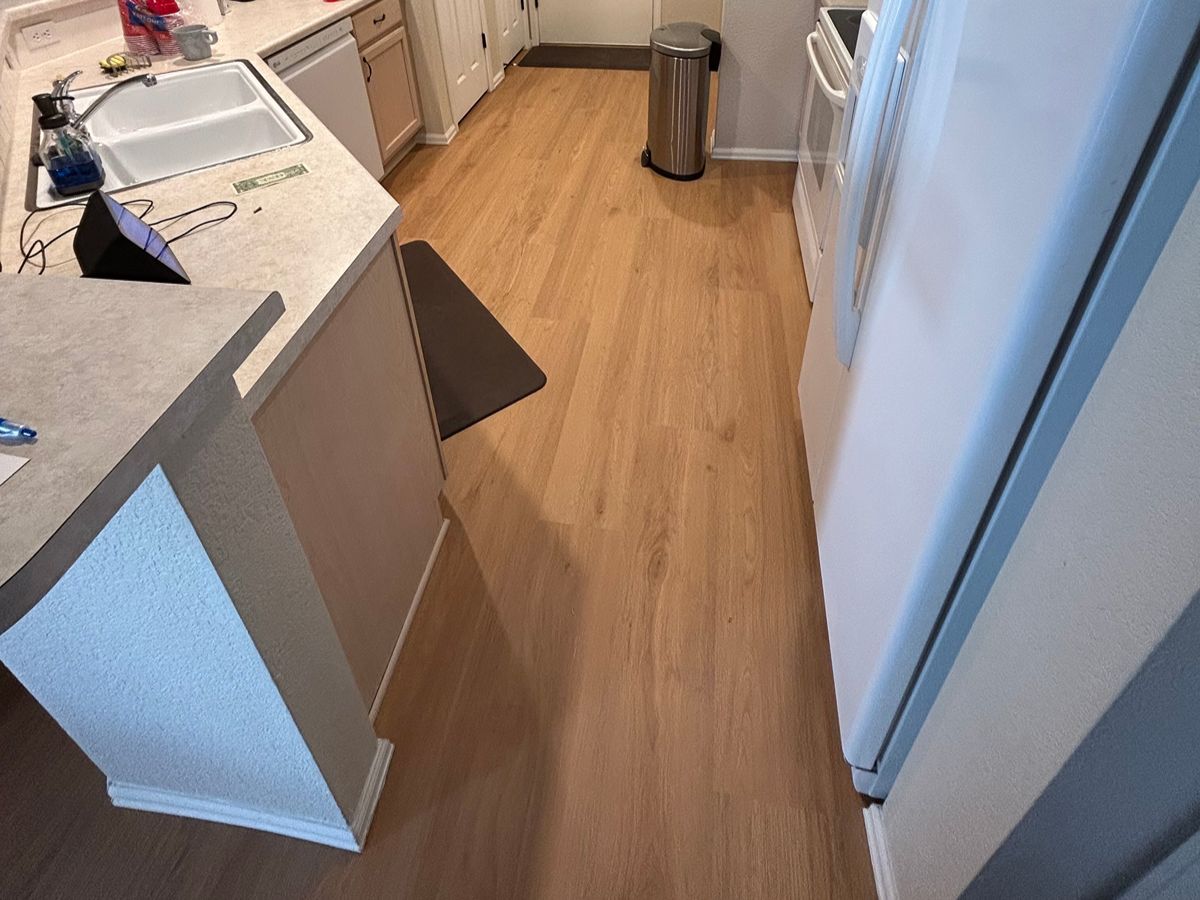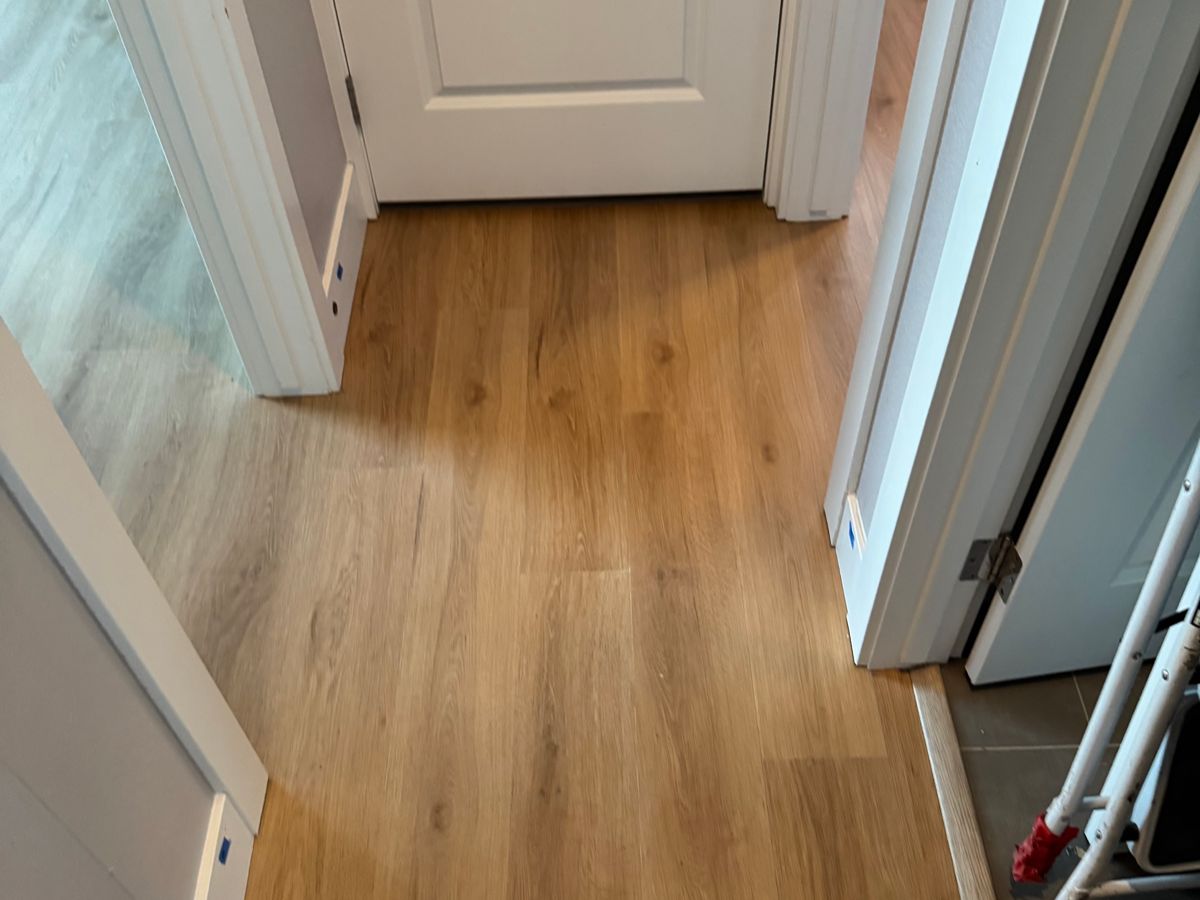
Most squeaking or shifting luxury vinyl plank in a Denver home traces back to one of three things: not enough room for the floor to move, a subfloor that was not flat, or joints that never fully clicked home during install. The fix depends on which one you have, and a good number of these you can sort out without tearing up the whole floor.
Denver sits at a spot where floors get worked hard by temperature more than by moisture. A vinyl floor near a big south or west window heats up during the day and cools when the AC kicks on, and that back-and-forth is enough to open joints or make planks rub if the floor was installed tight to the walls.
LVP is a floating floor in most Denver installs, which means the planks click together and rest on top of the subfloor instead of being glued or nailed down. The whole thing is meant to move as one sheet. When a plank squeaks, shifts underfoot, or pops apart at a seam, it is usually telling you that something is stopping that natural movement or that the planks are no longer locked together the way they should be. The sound and the shifting are symptoms. What you are actually chasing is the mechanical reason the floor cannot sit and move the way it was built to.
The local piece matters here because vinyl reacts to temperature far more than it reacts to humidity. Luxury vinyl plank reacts less to moisture and more to temperature, so a floor that sits in direct summer sun through a large window can push outward, then pull back when the air conditioning runs. Denver hands you plenty of that. On top of that, a 40-degree gap between a sunny afternoon and a clear night is normal here. That daily swing is exactly the kind of load that finds any tight spot or gap in an LVP install and turns it into a squeak.
Why is my vinyl plank flooring separating after installation?
Separating planks almost always come down to blocked or uneven movement. A floating LVP floor expands and contracts as a unit, and it needs a small gap left around the whole perimeter so it has somewhere to go. Professional installers leave a small expansion gap around the perimeter of the room to accommodate natural expansion and contraction, which prevents buckling, cracking, or lifting over time. When that gap is too small, or when a heavy cabinet or a run of trim pins the floor in place, the planks fight each other and pull apart at the weakest seams.
Sunlight makes this worse in Denver homes with large glass. When sunlight streams through windows onto your floor, it can create temperature differences of 30 to 40 degrees between sunlit and shaded areas, causing localized expansion in the heated areas while adjacent cooler areas stay stable, creating stress that pulls planks apart at their seams. A skipped or rushed acclimation before install adds to it too. Acclimation lets the flooring adjust to the room before installation, and skipping it can result in flooring that expands or contracts unexpectedly, leading to damage over time. If your planks near a patio door are drifting apart by afternoon and closing back up at night, you are watching temperature-driven movement, not a defect in the planks.
Should you worry about squeaky floors?
A little sound now and then is usually nothing. A floating floor rests on the subfloor rather than being fastened to it, so light noise as planks settle and slide against each other is normal, especially in the first few weeks after a Denver install while the floor finds its temperature. You do not need to panic over an occasional creak in a hallway.
What is worth attention is a squeak that comes with movement you can feel, a spot that flexes or drops slightly when you step on it, or a seam that is lifting. Those point to a subfloor that is not flat or planks that are not fully locked, and left alone that stress keeps working on the joints. Problems arise when natural movement is restricted or uneven: if expansion gaps are insufficient, the floor cannot expand properly and may buckle or separate, and if the subfloor is not level, certain areas bear more stress than others, causing localized separation. So the rule of thumb is simple. Steady, quiet floor that just talks once in a while is fine. A floor that moves, dips, or grows a gap needs a look before it turns into a bigger repair.
Can you fix squeaky floors without removing flooring?
Often, yes. Plenty of LVP squeaks get solved without pulling up the floor, and the right move depends on the cause. If the noise is coming from the perimeter where the floor is pinched, the fix can be as small as trimming the expansion gap back open behind the baseboard or shoe molding so the planks are not jammed against the wall. If a run of quarter-round was nailed down through the planks and is holding the floor still, freeing that trim so it pins to the wall instead often quiets things down.
Squeaks near a sunny door or window frequently ease once you cut the heat load. Using blinds and curtains during peak sunlight hours reduces the heat radiating through windows and doors onto the floor. Holding a steadier indoor temperature helps too, since keeping the indoor temperature between 65 and 80 degrees minimizes movement. When the noise is a real subfloor problem, a hollow or a loose spot, that is where it gets harder to solve from the top without opening things up, and it is worth having someone assess it before you guess. Our luxury vinyl plank installation in Denver starts with checking exactly these things, because most callbacks trace to the subfloor or the gaps rather than the planks.
How to stop a floor from shifting?
Stopping a floor from shifting means giving it a flat base and controlled room to move, then keeping it from being pinned. A floating LVP floor that shifts is usually sitting on a subfloor with high and low spots, so the planks rock and slide instead of resting flat. Getting the subfloor within a tight flatness tolerance before install is what keeps the floor stable underfoot, and it is the step that gets shortcut most often.
The other half is managing the conditions the floor lives in. A few things that help in a Denver home:
- Keep the perimeter expansion gap intact and never let baseboard or heavy furniture trap the floor against a wall.
- Hold indoor temperature reasonably steady, since sharp day-to-night swings drive the movement that loosens joints.
- Cut direct sun on the floor with blinds, curtains, or film at big south and west windows and patio doors.
If planks have already separated or loosened, they can usually be re-seated by working the joints back together and squaring the floor back up, rather than replacing material. When shifting keeps coming back, it is a sign the base or the gaps still are not right, and that is worth a professional set of eyes.
A squeaking or drifting LVP floor in a Denver home is frustrating, especially when the daily temperature swings out here keep pushing on every tight spot and gap. Our vinyl flooring installation in Denver covers exactly this work, from tracking down the real cause to re-seating planks and correcting the subfloor, and every job we do carries a full 18-month warranty: if something needs fixing in that window, we come out and fix it completely at no charge, whether the problem came from the install or from something that happened afterward. If you want a clear read on your floor, reach out to CMC Flooring for a free in-home estimate where we bring samples so you can see materials in your own light, or call us at (720) 382-3006.