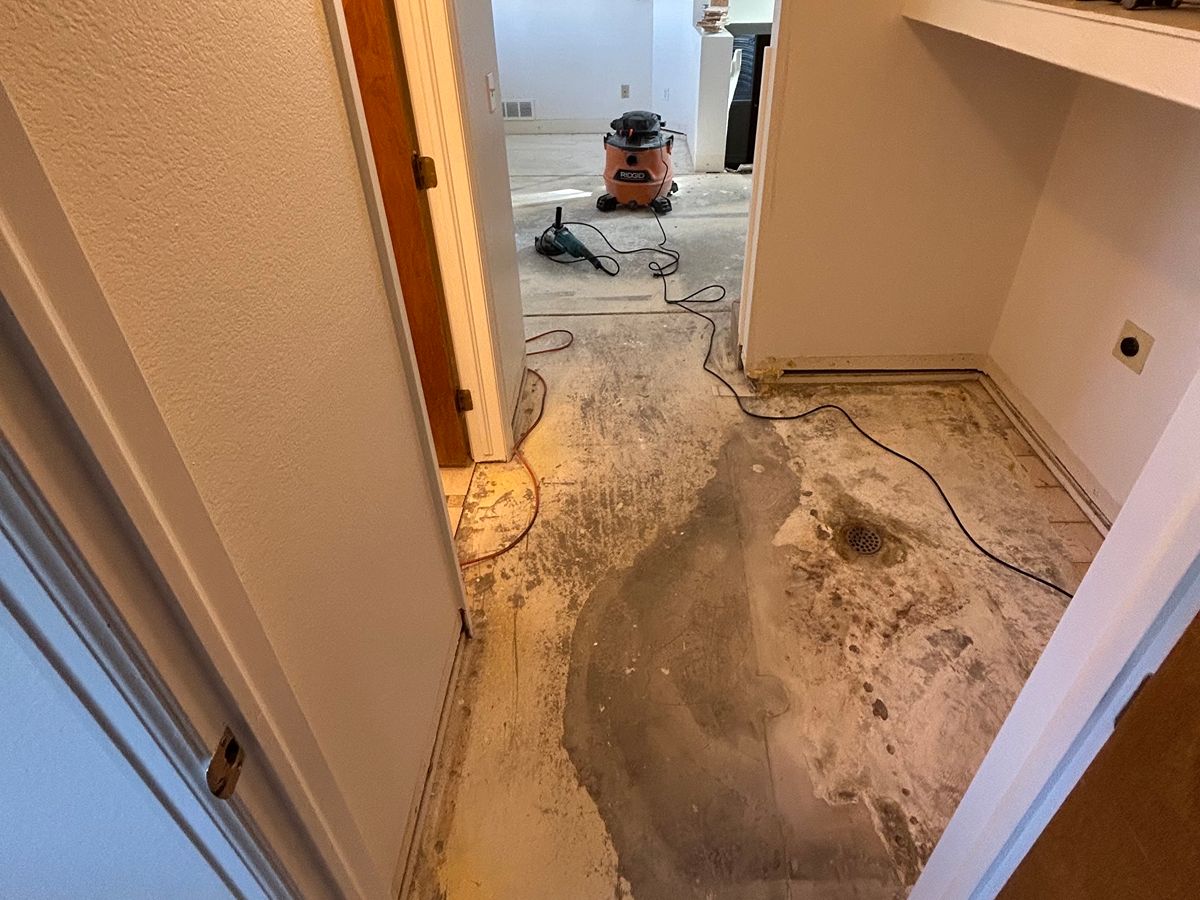
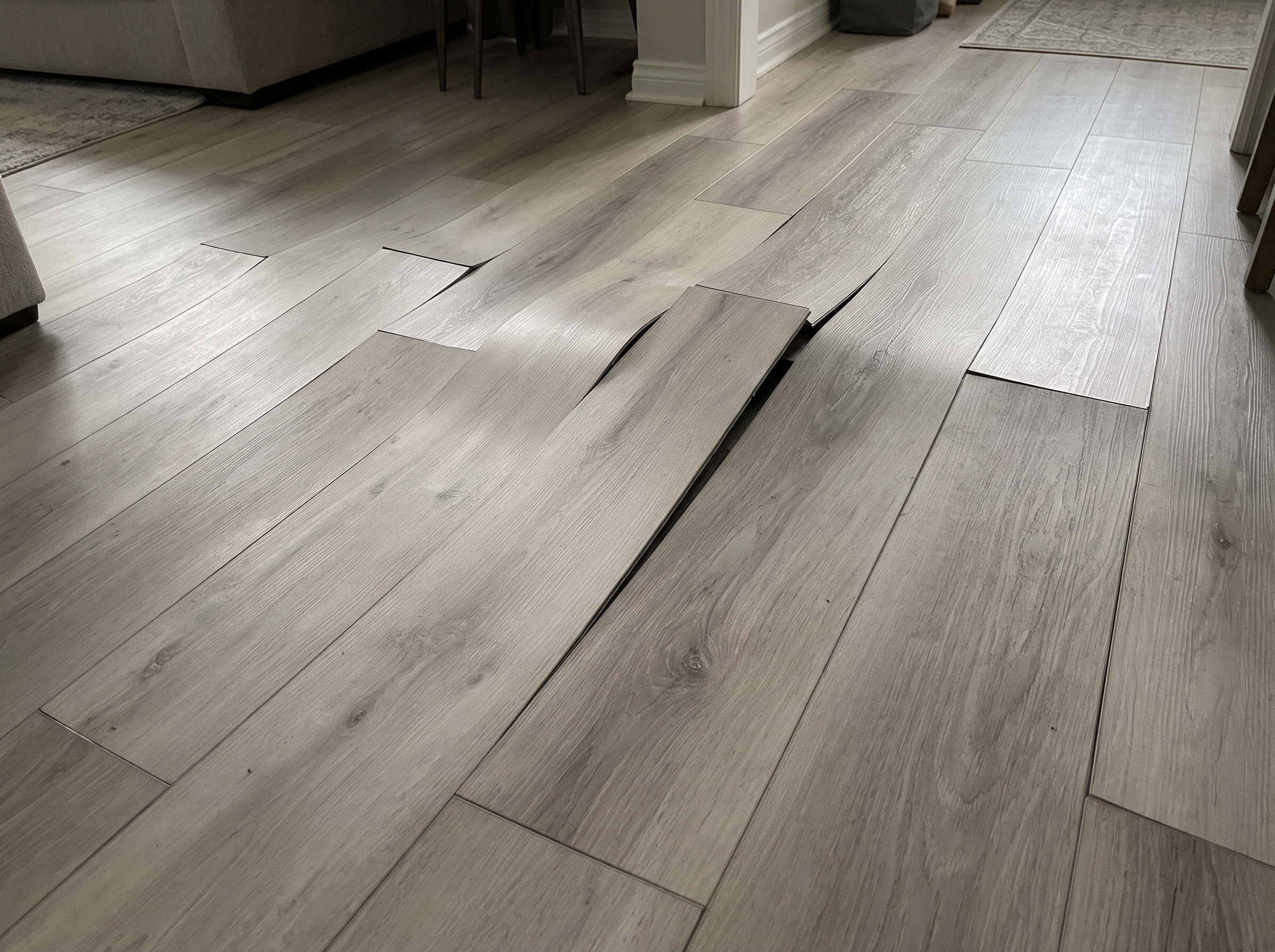
Laminate that separates in a Denver winter is often reacting to dry indoor air: once the furnace runs, the planks can lose a little moisture and shrink enough to open the seams. Dry air is not the only cause, though. Joints that never fully locked, an uneven subfloor, or cabinets and heavy furniture pinning the floor can open gaps too.
You notice it right around the time the furnace has been running for weeks. The static shocks, the dry skin, the cracking around door casings, and then those thin gaps between planks that were not there in October.
Laminate has a fiberboard core, and like other wood-fiber products it can take on and give off a little moisture as the air around it changes. When your furnace heats already-dry Colorado air, the relative humidity inside drops, and the core loses moisture and shrinks a little. Because laminate is a floating floor made of planks clicked together at the edges, that small amount of shrink across a whole room adds up, and the seams pull apart into visible gaps. When indoor humidity comes back up in spring, seasonal gaps can close up again.
Heating cold winter air drops its relative humidity sharply, so a Denver home running the furnace can end up well below where laminate makers want it. Major laminate manufacturers call for keeping the room between 35 and 65 percent relative humidity, and a dry heated house in January can fall under the low end of that window.
How do you fix laminate flooring that is separating?
Start by figuring out why it separated, because the fix depends on the cause. If the gaps opened up gradually over the winter and the floor is otherwise flat and solid, seasonal shrinkage from dry air is the likely cause, and the fix is to raise and hold your indoor humidity in the range the manufacturer calls for, commonly 35 to 65 percent. A whole-home or portable humidifier is the usual way to get a Denver home there in January, and seasonal gaps can close back up as the air moistens.
If a gap does not close, or if a plank has clearly popped up or shifted, the floor can often be pulled back together. Because laminate floats, an installer can sometimes lift planks from the nearest wall, re-seat the joints so they lock fully, and work back across the room. What you should not do is caulk, glue, or fill the gaps, since that pins a floor that is supposed to move and usually trades a small winter gap for a bigger problem later.
Can you replace a section of damaged laminate flooring?
Yes. Because laminate is a floating, click-together floor, a single damaged plank or a small run of planks in the middle of a room can be swapped out without tearing up the whole floor. That is one of the real advantages of laminate over a glued-down floor.
There are two common ways to do it. An installer can carefully take up planks from the nearest wall, replace the bad ones, and re-lock everything back across the room. Or, when pulling from a wall is not practical, the damaged plank can be cut out in place and a replacement glued or clicked into the opening. The bigger question is whether you still have matching planks. Laminate colors and collections get discontinued, so if the floor is a few years old, an exact match may be hard to find and the repair might stand out. This is why holding onto your leftover boxes after an install is worth doing. If you kept a couple of spare planks in the garage, a mid-floor repair goes a lot more smoothly.
What are some common mistakes people make when installing laminate flooring?
Several installation mistakes make winter separation more likely, and skipping acclimation is one of them. Manufacturers call for the unopened cartons to sit in the room for at least 48 hours before install, and at least one major brand asks for 96 hours in very dry climates, so the planks can adjust to that room’s temperature and humidity before they are locked together.
Other mistakes to watch for:
- Closing up the perimeter expansion gap. A floating floor has to be able to move, and major manufacturers call for at least a 3/8-inch gap around the walls, hidden under the baseboard. Butting planks tight to the wall leaves no room to shift.
- Not locking the joints fully, so a seam looks closed but was never seated. That joint is the first place to open when the floor moves.
- Installing over an uneven subfloor. Dips and high spots stress the click joints, and over a Denver slab or basement floor that has not been leveled, seams work loose.
- Trapping the floor with cabinets or heavy furniture set on top of it, which pins one area while the rest of the floor tries to move around it.
How can I prevent laminate flooring from separating?
The most effective thing you can do in Denver is manage your indoor humidity through the heating season. Since laminate makers call for 35 to 65 percent relative humidity and a heated Denver home can drop well below that, a humidifier is the tool that keeps a floor stable. An inexpensive digital hygrometer lets you actually see the number instead of guessing, and you can run the humidifier to hold the room steady rather than letting it swing.
The rest is about how the floor was put in. Give the planks their full acclimation time before install, keep that expansion gap open around the whole perimeter, make sure the subfloor is flat, and confirm every joint is fully locked. Do not push furniture or cabinets tight in a way that traps the floor. In a basement or slab install, a proper moisture barrier under the laminate also matters.
If your floor is gapping this winter, the first step is finding out whether it is the air, the install, or something pinning the floor. We install laminate flooring in Denver, bring samples to your home so you can compare options in your own lighting, and back every job with a 100 percent satisfaction guarantee and a full 18-month warranty: if anything needs fixing in that window, we fix it at no charge, including problems you caused yourself. Want us to look at it? Send us a note about your floor or call CMC Flooring LLC at (720) 382-3006, and we will check it in person with a free in-home estimate.